Posts

Three Laws of Graduation

Circa 2108 Sir Icaas Tewnon, though famous for his seminal work in Mechanics, his theories on the prediction of graduation formulated during while still a grad student at the Jaypee Institute of Information Technology remain his most important contribution to the academia. First published in 2079, Sir Icaas Tewnon's "Procrastinare Unnaturalis Principia Mathematica" is often considered one of the most important single works in the history of science. First Law "A graduation student in procrastination tends to stay in procrastination unless an external force is applied to it" This postulate is known as the "Law of Inertia" and was originally discovered experimentally by Lagileo four years before Tewnon was born when he threatened to cut his grad student's funding. This resulted in a quickening of the student's research progress. Lagileo's observations were later perfected by Tescades through the application of " Weekly Meetings "....

BarCampDelhi4

Image
BarCamp is here! And its happening! When? Date: May 17th, 2008 (Saturday) Time: 0900 hrs - 1800 hrs IST Where? Amity Innovation Incubator Auditorium, Block C Amity University Campus Sector 125, Noida Ph: +91.120.465.9000, 465.9151 Click here for driving directions. Wait a minute! Jeeves.. What's a BarCamp? BarCamp is an international network of user generated conferences — open, participatory workshop-events, whose content is provided by participants — often focusing on early-stage web applications, and related open source technologies, social protocols, and open data formats. It is an ad-hoc gathering born from the desire for people to share and learn in an open environment with intense events and discussions, demos and interaction from participants. What about BarCampDelhi4? BarCampDelhi4 is the fourth edition of a BarCamp in the Delhi region. It is proposed to be a camp to get together and discuss/rant/brain-storm/share opinions/information/wisdom about anything. Be it web Te...

Art of Logo Design

Copyright January 2006: Niyam Bhushan. Inspired by the vision of Osho. Published under the Free Documentation License (FDL) 01: Must Be A Shape A simple, vector, shape. Exactly like a glyph. Imagine the alphabet with a new character-shape added to it. Thus, a logo has to be the most primal shape you can imagine. At times, a logo could also contain more than one shape in it. 02: Must Be Scalable As a shape, the logo must scalable from about 5mm mm in size, to about the size of a football field, without distortion. To test the scalability of your logo, start with a logo that is scaled to 5mm in size, make a copy double its size, and go on doing this until you fill an entire sheet. Then print it out and see if the shape loses any detail or suffers from any sort of distortion. Sometimes, a minimum scalable size of around 1 cm is also acceptable, though it does limit the use of the logo conditions where you have to use it less than this size, for example on a tie-pin, or printed on co...

Ways to get into Facebook

Facebook has some weird ways of getting its employees. Solve any of these puzzles they are currently facing and simply apply! Some of the many puzzles... Prime Bits First, consider a function P(x) where: P(x) returns: true if the number of 1 bits set in the binary representation of x is prime, false otherwise. For example, P(239) returns true , while P(51) returns false . Next, consider the following function prime_bits : uint64_t prime_bits( uint64_t a , uint64_t b ) ; A call to prime_bits(a, b) returns the number of values between a and b inclusive for which P(x) is true. For example, prime_bits(4, 10) returns 5 , while prime_bits(137, 31415926535897 ) returns 7753256197126 . Your job is to implement the prime_bits function. Your implementation should be efficient, and it should be wrapped up nicely such that one can specify a and b on the commandline when running your program. You may expect the range of a and b to be lim...

Le Bleu et le Rouge

Image
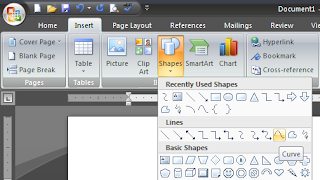
Using this Method you can start creating masterpieces of Abstract Art within five minutes. No assistance from any Genius is needed. The only prerequisite is Microsoft Word on your PC. 1. In the AutoShapes menu select Curve under Lines. 2. Move the mouse aimlessly, left-clicking occasionally, and you will get something like this: 3. Point the arrow towards any point on your curve and left-click. Keep the arrow in the same position and right-click. In the menu that will appear select “Format AutoShape”. 4. In the Format AutoShape menu choose Fill Color and Line Color. In the present example they both were chosen green. You will see something like this: 5. Now let us make the background. In the AutoShapes menu select Basic Shapes, than select Rectangle. Make a rectangle about the size of the figure. Than in the Format AutoShape menu choose the Fill Color for this rectangle. In the present example it was selected red. Now drag the green figure over the red rectangle. 6. Finally name it in...

Top 10 Signs You’re a JIIT Batch 2009 Student

(drum roll) 10. You prefer writing C, C++ and C# (CS/IT dudes) or Matlab and VHDL (ECE folks) over writing English. 9. You prefer meeting your room-mate over a game of Counter Strike or Dota rather than face-to-face and swear at your wing-mates loudly when they easily frag you in the game rather meekly (@#$% @#$ @#$%!). 8. There are no windows in your room…and you like it. 7. You are currently reading this on your laptop screen, with your laptop positioned in such a way that you can sleep comfortably on your hostel-bed and still be able to read it (Note that extensive use of these pixels makes them die faster.. so I suggest you use your room-mate's monitor to do your daily web browsing, without the comforts of your bed though) 6. You understand most of the jokes on xkcd . 5. You understand all of the jokes and are a contributing source to the forums of PhD Comics . 4. You run at the slightest sight of Prof. A Pathak, towards your 'workstation' and flood IP Messenger with l...

Who Wants to MARRY a GRAD STUDENT??

Image